
Driveway Repair vs. Replacement: Making the Right Call
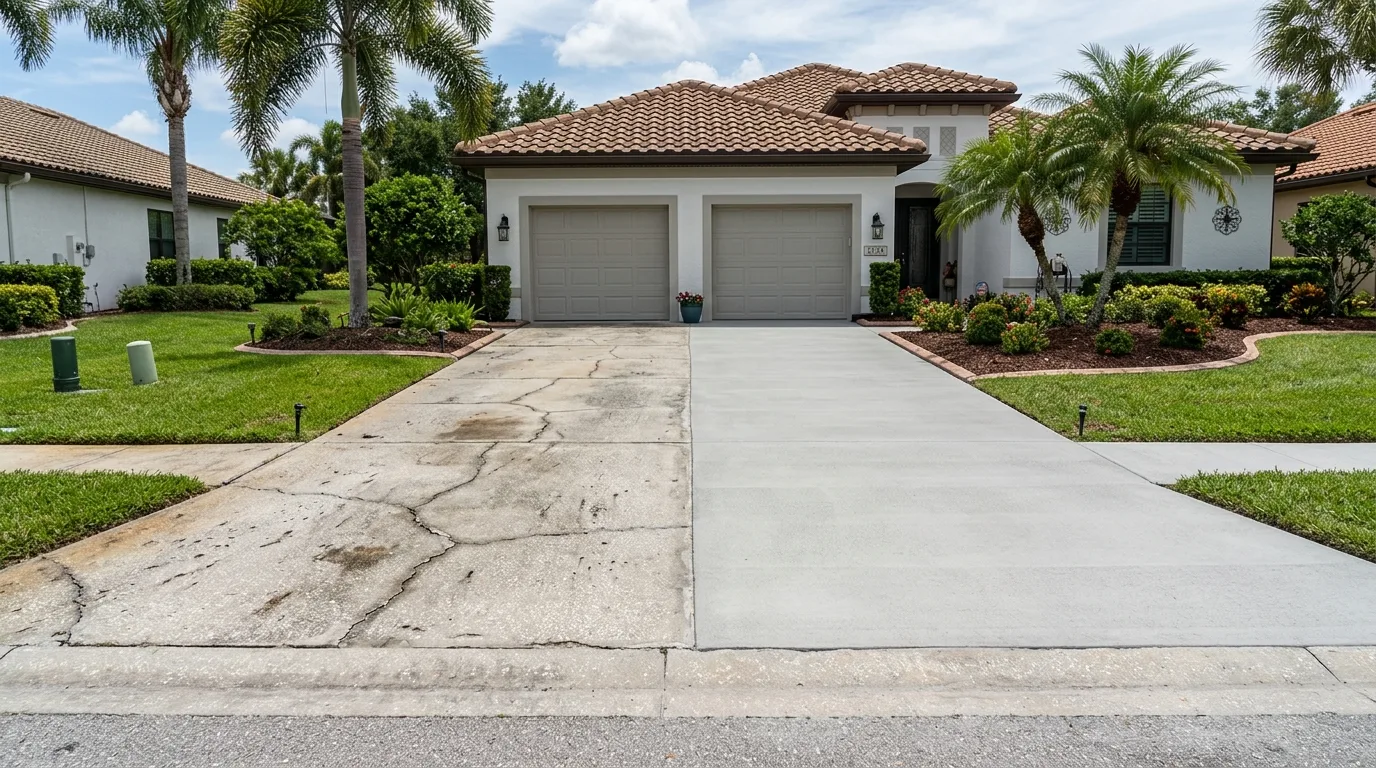
You’re staring at a cracked driveway, and the contractor quote covers two very different scopes — a quick repair or a full replacement. Without a clear framework, it’s hard to know which option actually makes sense for your situation. In this post, we cover a practical decision framework for Poinciana homeowners, real cost comparisons, and the specific damage patterns that should tip you toward one option or the other.
Get an Honest Repair vs. Replacement Recommendation
We assess the real cause before recommending either option.
Why This Decision Trips Up So Many Homeowners
Contractors have a financial incentive to recommend the larger, more expensive job — which makes it hard for homeowners to know if a “you need full replacement” recommendation is genuinely necessary or simply more profitable for the company giving the quote. A clear, repeatable framework removes the guesswork and lets you evaluate any recommendation against objective criteria.
The good news is that the decision usually isn’t actually close once you apply the right criteria — most driveways clearly fall into “repair makes sense” or “replacement makes sense” categories once you look past the surface-level cracking and assess the underlying cause. The harder cases tend to be the ones where damage looks severe but is actually cosmetic, or where damage looks minor but is masking a more serious sub-base problem underneath.
The Decision Framework
Choose repair when: Damage is isolated to less than 25% of the surface, cracks are stable rather than actively widening, the driveway is less than 20 years old, and there’s no evidence of widespread sub-base failure like multiple sunken sections.
Choose replacement when: Cracking covers more than a third of the surface, multiple sections show settlement, repairs have failed repeatedly in the same spots, or the driveway is 25+ years old with no major resurfacing ever performed.
Get a professional assessment when: The damage falls somewhere in between, or you’re unsure whether visible cracking reflects a stable, cosmetic issue versus an active, worsening structural problem.
Cost Comparison in Practice
- Isolated crack repair: A few hundred dollars for one or two cracks, the most economical option when damage is truly limited and stable.
- Resurfacing overlay: $5–$14 per square foot, a middle-ground option that restores appearance and minor structural issues across a full driveway without complete demolition.
- Full replacement: $2,400–$10,800 depending on size and finish, the most expensive option but the only one that fully corrects sub-base problems.
- Repeated repair costs: If you’ve already spent $1,500+ on repairs that haven’t held, that spending should factor into your replacement decision as sunk cost that didn’t solve the underlying problem.
- Resale timing: If you’re planning to sell within the next few years, a fresh full replacement often shows better in listing photos and inspection reports than a driveway with visible, even if minor, patch repairs.
How the Decision Plays Out for Poinciana Specifically
Osceola County’s poorly drained, sandy soil means a meaningful share of driveway damage in Poinciana traces back to sub-base settlement rather than purely cosmetic surface wear. This matters for the repair-vs-replacement decision because surface-level repairs — crack filling, resurfacing — don’t correct sub-base problems. If your damage is driven by soil movement beneath the slab, repair will likely need to be repeated, while replacement with proper compaction addresses the root cause.
Driveways in older sections of Poinciana Villages, built before today’s compaction standards were common practice, more frequently fall into the replacement category specifically because the original base preparation wasn’t built to handle this area’s soil conditions over multiple decades. Newer construction generally fares better under this framework, since current base-prep standards already account for the soil challenges that older installations were never designed to handle.
Apply This Framework to Your Poinciana Driveway
Get a free, no-pressure assessment from our team.
Cost Factors That Shift the Calculation
Demolition adds $2–$4 per square foot to a replacement project, which should factor into any direct cost comparison against repeated repair costs. On the other hand, a driveway that’s failed repair twice already has effectively spent money without solving the problem — that sunk cost shouldn’t be a reason to avoid replacement if it’s genuinely the better long-term option.
Permit costs ($50–$500) and Notice of Commencement requirements for jobs over $5,000 apply to replacement but generally not to smaller repair work, a modest but real cost difference worth factoring into your budget comparison.
Frequently Asked Questions
How do I know if my driveway damage is structural or cosmetic?
Structural damage typically involves multiple cracks running through the full slab depth, visible settlement or unevenness, or cracks that have grown noticeably over a few months. Cosmetic damage is usually limited to surface-level discoloration, minor hairline cracks, or isolated small chips that haven’t changed in appearance over time.
Can I repair just the worst section and leave the rest of the driveway alone?
Yes, partial replacement of a clearly worse section while leaving structurally sound areas intact is a common and cost-effective approach, particularly when damage is concentrated in one area like a sunken corner near the garage.
Is it ever worth replacing a driveway before it’s fully failed?
Sometimes — if you’re already planning other exterior renovations, or if repeated minor repairs are adding up to a significant fraction of replacement cost, proactively replacing an aging driveway can make more financial sense than continuing the repair cycle.
Get Your Free Repair vs. Replacement Assessment
Call Poinciana Concrete Pros for an honest evaluation today.
Related: